Best Portable Power Stations for Car Camping & Road Trips (2026)

We may earn a commission when you buy through links on this page, at no extra cost to you. It never affects which products we recommend. How we’re funded.
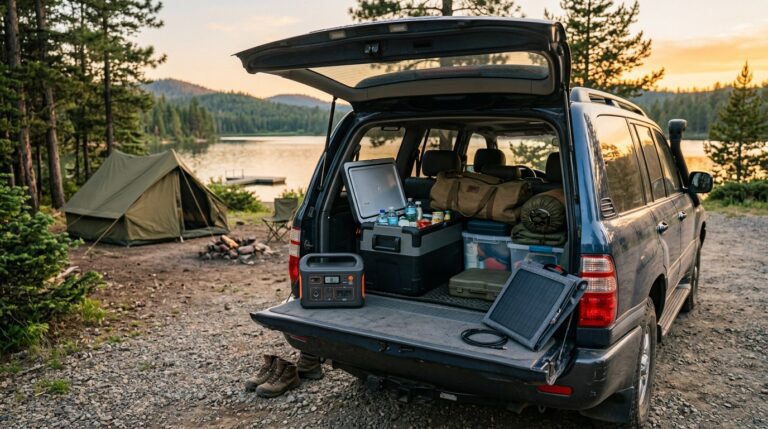
A portable power station turns your car into a campsite with electricity: a 12V fridge that stays cold overnight without draining the starter battery, laptops and camera batteries topped up on a three-day trip, a CPAP running silently through the night, and coffee in the morning without a generator waking the whole campground. The trouble is that the listings are a wall of watt-hours and surge ratings, and most guides just repeat them.
This guide does the maths for you. We picked seven current-generation power stations, all with LiFePO4 batteries (the long-life chemistry — 3,000+ charge cycles instead of 500), all in stock on Amazon.com in September 2026, and matched each one to the trip it actually fits: a weekend in the car, a week of car camping with a fridge, or a full van build. Prices run from about $250 to $1,200, and for most road-trippers the right answer is in the $280–$560 band.
Quick answer
- Best overall for car camping: EcoFlow DELTA 3 Classic — 1,024Wh, 1,800W, 5,000+ ratings, ~$500
- Best for a weekend trip: BLUETTI Elite 30 V2 — 288Wh, 600W, 9.4 lb, ~$280
- Best mid-size all-rounder: Jackery Explorer 1000 v2 — 1,070Wh, 1,500W, 23.8 lb, ~$560
- Most portable: EcoFlow RIVER 2 — 243Wh, 7.7 lb, 1-hour recharge, ~$250
- Best for laptops & cameras: Anker SOLIX C300 — 288Wh with two 140W USB-C ports, ~$330
- Best for long trips & van life: Anker SOLIX S2000 — 2,010Wh at 35.7 lb, ~$1,000
The seven compared
| Power station | Capacity | AC output | Weight | Runs a 45W car fridge* | Best for | |
|---|---|---|---|---|---|---|
| EcoFlow RIVER 2 ~$250 | 243Wh | 300W (600W X-Boost) | 7.7 lb | ~9 hours | Overnights, phones & lights | Check price → |
| BLUETTI Elite 30 V2 ~$280 | 288Wh | 600W (1,500W lifting) | 9.4 lb | ~11 hours | Weekend trips, CPAP | Check price → |
| Anker SOLIX C300 ~$330 | 288Wh | 300W (600W surge) | ~9 lb | ~11 hours | Laptops, cameras, drones | Check price → |
| EcoFlow DELTA 3 Classic ~$500 | 1,024Wh | 1,800W (3,600W surge) | ~27 lb | ~38 hours | Car camping with a fridge — best value | Check price → |
| Jackery Explorer 1000 v2 ~$560 | 1,070Wh | 1,500W (3,000W surge) | 23.8 lb | ~40 hours | Lightest 1kWh unit; families | Check price → |
| EcoFlow DELTA 3 ~$630 | 1,024Wh (expandable to 5kWh) | 1,800W (3,600W surge) | ~27.5 lb | ~38 hours | Fast charging, future expansion | Check price → |
| Anker SOLIX S2000 ~$1,000 | 2,010Wh | 1,500W (3,000W surge) | 35.7 lb | ~75 hours | Week-long trips, van life | Check price → |
*Estimated: usable capacity × ~85% inverter efficiency ÷ 45W average draw of a compressor fridge cycling at roughly 50%. Real runtime depends on ambient temperature and how often you open the lid. Prices checked September 2026 on Amazon.com and change often.
How to size a power station for a road trip
Ignore the marketing names and look at two numbers. Watt-hours (Wh) is the size of the tank — how much energy is stored. Watts (W) is the size of the tap — how much it can deliver at once. A 288Wh unit can’t run a 1,000W kettle no matter how you plug it in; a 1,024Wh unit can, for about an hour. Here’s what common road-trip loads actually use:
| Device | Typical draw | From 288Wh | From 1,024Wh | From 2,010Wh |
|---|---|---|---|---|
| Phone (full charge) | ~15Wh | ~16 charges | ~58 charges | ~115 charges |
| Laptop (full charge) | ~60Wh | ~4 charges | ~14 charges | ~28 charges |
| 12V compressor fridge | ~45W avg | ~11 hours | ~38 hours | ~75 hours |
| CPAP (no humidifier) | ~30–40W | ~1 night | ~3 nights | ~6 nights |
| Electric kettle | 1,000–1,500W | Won’t run | ~8–10 boils | ~18 boils |
| Induction hob (low) | ~800W | Won’t run | ~1 hour | ~2 hours |
The rule of thumb: phones, lights and a laptop for a weekend → 250–300Wh. Add a fridge for two or three nights → 1,000Wh. A week off-grid, cooking on electric, or a van → 2,000Wh and a solar panel. Two other things worth paying for: LiFePO4 cells (every unit here has them; they last 3,000–10,000 cycles versus 500–800 for older lithium-ion) and fast AC charging, so a one-hour lunch stop at a diner outlet refills the tank.
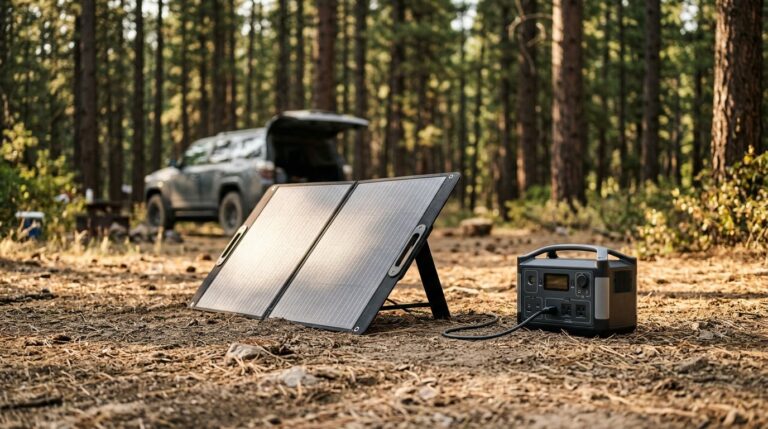
Where the money is wasted: solar-panel bundles. Amazon lists most of these units two or three times with a 100W or 220W panel added for $150–250 extra. A folding panel is genuinely useful for trips of four days or more, but for weekenders it stays in the trunk. All links in this guide go to the base unit; add a panel later if you find yourself needing it.
The picks
#1 · Best overall for car camping
EcoFlow DELTA 3 Classic
1,024Wh LiFePO4 · 1,800W AC (3,600W surge, 2,600W X-Boost) · 0–80% in 45 min from the wall · 500W solar input · 10ms UPS · 10-year rated cells · App control
The DELTA 3 Classic is the sweet spot of the whole market right now: a full kilowatt-hour, an 1,800W inverter that runs anything you’d bring on a car trip including a kettle or a small induction hob, and a price that regularly sits around $500. It’s the most-reviewed unit in this guide by a wide margin (5,000+ ratings at 4.5 stars), and the newer “Classic” name simply means it’s the standard DELTA 3 body without the expansion port — which matters to almost nobody who camps out of a car.
The feature that changes how you travel is the recharge speed. EcoFlow’s X-Stream charging takes it from empty to 80% in about 45 minutes from any wall outlet, so a lunch stop refills a fridge-night’s worth of power. On a 45W compressor fridge you get roughly a day and a half per charge; add a 220W panel and you’re effectively off-grid indefinitely in summer. The catch is weight — around 27 lb — and that the listing we link includes a solar cable adapter, which is fine (you’ll want it) but adds a few dollars over the bare unit.
Pros
- 1,800W runs kettles, hobs and hair dryers
- 80% recharge in ~45 minutes
- 5,000+ ratings — a proven unit
- Best price per watt-hour of any 1kWh unit here
Cons
- ~27 lb — a two-hand lift into the trunk
- No extra-battery expansion (see DELTA 3 below)
- Fan is audible when charging fast
Who should buy it: anyone car camping with a fridge for two or more nights, or who wants one unit that also covers a home power cut. Skip it if: your trips are one night with phones and a lamp — the Elite 30 V2 does that at a third of the weight.
Check price on Amazon →~$499 when checked, September 2026.
#2 · Best for a weekend trip
BLUETTI Elite 30 V2
288Wh LiFePO4 · 600W AC (1,500W Power Lifting) · 9.4 lb · 0–80% in 45 min · 10ms UPS · 4.5W standby draw · 8 charging modes
Small power stations usually force a compromise: 300W of output, which rules out anything with a heating element. The Elite 30 V2 breaks that rule with a 600W inverter and a “Power Lifting” mode that lets resistive loads — a travel kettle, a small toaster — draw up to 1,500W by trimming the voltage. From a 9.4 lb box that fits behind a car seat, that’s remarkable. It’s also unusually efficient: 4.5W standby means it doesn’t quietly drain itself between trips the way many small units do.
The 288Wh capacity covers a weekend of phones, camera batteries and a laptop with room to spare, or a full night on a CPAP without the humidifier. It won’t run a fridge for more than about 11 hours, so it’s the wrong choice if cold food is the goal. BLUETTI’s listing is newer than the EcoFlow and Anker rivals, with a few hundred ratings rather than thousands — the brand’s track record on the older EB3A is solid, but it’s worth knowing.
Pros
- 600W output — double most units this size
- Power Lifting runs a kettle from a 9 lb box
- Very low standby drain
- Fast 45-minute charge to 80%
Cons
- 288Wh is a weekend, not a week
- Fewer owner reviews than EcoFlow/Anker so far
- Power Lifting only works for heating-type loads
Who should buy it: weekend campers, CPAP users, and anyone who wants coffee-making power without carrying 25 lb. Skip it if: you’re running a fridge overnight more than once — step up to the DELTA 3 Classic.
Check price on Amazon →~$279.99 when checked, September 2026.
#3 · Best mid-size all-rounder
Jackery Explorer 1000 v2
1,070Wh LiFePO4 · 1,500W AC (3,000W surge) · 23.8 lb · Full charge in 1 hour (emergency mode) · 3 AC, 2 USB-C (100W), 1 USB-A, 12V car port · Foldable handle · App control
Jackery is the brand most people already know, and the 1000 v2 is why: it’s the lightest kilowatt-hour unit in this guide at 23.8 lb, with a handle that folds flat so you can stack a cooler on top. Capacity is a touch higher than the EcoFlows (1,070Wh vs 1,024Wh), the 1,500W inverter runs everything short of a full-size kettle at full boil, and the LFP cells are rated to 4,000 cycles — roughly ten years of daily use.
Charging is quick — a full charge in 1.7 hours by default, or one hour with the app’s emergency mode — and the port layout is sensible for a car: three AC sockets, two 100W USB-C, and a 12V socket for a fridge. What you pay for over the DELTA 3 Classic is about $60 and 300W of inverter headroom, in exchange for 3 lb less weight and Jackery’s very good customer service reputation. For families with kids and a lot of devices, that trade often makes sense.
Pros
- Lightest 1kWh unit here — 23.8 lb
- Folding handle; stackable in the trunk
- 4,000-cycle LFP battery
- Two 100W USB-C ports for laptops
Cons
- 1,500W inverter vs 1,800W on the EcoFlows
- Slightly pricier per Wh than the DELTA 3 Classic
- Avoid the solar bundles unless you’ll use the panel
Who should buy it: families and anyone who lifts the unit in and out of the car often. Skip it if: you plan to cook on electric — the extra 300W of the DELTA 3 Classic is worth having.
Check price on Amazon →~$559 when checked, September 2026.
#4 · Most portable
EcoFlow RIVER 2
243Wh LiFePO4 · 300W AC (600W X-Boost) · 7.7 lb · Full charge in 1 hour · 3,000-cycle battery · 5-year service
The RIVER 2 is the one to keep in the car permanently. At 7.7 lb it weighs less than a gallon of water, it recharges completely in an hour from a wall socket, and it holds enough to charge a phone 16 times or run LED camp lights and a Bluetooth speaker for several nights. With 2,400+ ratings it’s the established small unit in the category, and the 5-year service commitment is unusual at this price.
Be realistic about what 243Wh and 300W mean: a laptop four times, a fridge for one short night, and nothing with a heating element even with X-Boost. If you’ll ever want to run a CPAP or a kettle, spend the extra $30 on the BLUETTI above. If you want the lightest, cheapest reliable box for phones, lights and cameras, this is it.
Pros
- 7.7 lb — genuinely one-hand portable
- 1-hour full recharge
- Lowest price of the group
- 2,400+ ratings, 5-year service
Cons
- Smallest capacity here (243Wh)
- 300W won’t run heating appliances
- Single AC outlet
Who should buy it: solo travellers and anyone who wants an always-in-the-car backup for phones, lights and a laptop. Skip it if: a CPAP or a fridge is on the packing list.
Check price on Amazon →~$249 when checked, September 2026.
#5 · Best for laptops, cameras & drones
Anker SOLIX C300
288Wh LiFePO4 · 300W AC (600W surge) · 3 AC outlets · 2× 140W USB-C + 1× 15W USB-C + USB-A · 120W car socket · 0–80% in 50 min · 25dB quiet
The C300’s trick is its ports. Two USB-C outputs at 140W each mean you can fast-charge a 16-inch MacBook Pro and a second laptop simultaneously without touching the AC inverter — which matters, because skipping the inverter saves 10–15% of your battery. Add three AC outlets and a 120W car socket and it’s the best-organised small power station for anyone travelling with camera gear, drones or a mobile office.
Capacity and inverter power match the BLUETTI (288Wh, but only 300W AC, no power-lifting mode), and it costs about $50 more. The extra buys Anker’s build quality, a near-silent 25dB fan, and those USB-C ports. Note that it isn’t compatible with Anker’s cheaper USB-C solar panels — you need the 60W or 100W SOLIX panel if you go solar.
Pros
- Two 140W USB-C ports — rare at this size
- Three AC outlets plus car socket
- Very quiet; 1,700+ ratings at 4.5 stars
- 5-year warranty
Cons
- 300W AC — no kettle, no hair dryer
- Pricier than the BLUETTI with the same capacity
- Picky about which solar panels it accepts
Who should buy it: photographers, remote workers and drone pilots who charge mostly over USB-C. Skip it if: you don’t own 100W+ USB-C devices — the BLUETTI gives you more power for less.
Check price on Amazon →~$329.99 when checked, September 2026.
#6 · Best if you might expand later
EcoFlow DELTA 3
1,024Wh LiFePO4 · 1,800W AC (3,600W surge) · Full charge in 56 min · Expandable to 5kWh with extra batteries · IP65 battery pack · 4,000 cycles · Powers 13 devices at once
Same battery and inverter as the DELTA 3 Classic, about $130 more. What the extra buys is the expansion port: plug in a DELTA 3 Extra Battery later and you double the capacity without replacing the unit, up to 5kWh. It also charges slightly faster (56 minutes to full) and the battery pack carries an IP65 rating against splashes and dust — reassuring in the back of a pickup.
If you’re sure a kilowatt-hour is all you’ll ever need, buy the Classic and pocket the difference. If there’s a van build or a bigger trailer in your future, the standard DELTA 3 is the version that grows with you.
Pros
- Expandable to 5kWh
- 56-minute full recharge
- IP65-rated battery pack
- Same 1,800W muscle as the Classic
Cons
- ~$130 over the Classic for features you may never use
- Same ~27 lb weight
Who should buy it: anyone planning to add capacity in a year or two. Skip it if: you’re not — the Classic is the same experience for less.
Check price on Amazon →~$629 when checked, September 2026.
#7 · Best for long trips & van life
Anker SOLIX S2000
2,010Wh LiFePO4 · 1,500W AC (3,000W surge) · 35.7 lb · 6W idle draw · 10,000-cycle cells · 400W solar input · 8 outlets front and rear · 10ms UPS
Two kilowatt-hours used to mean a 50–60 lb box. The S2000 packs 2,010Wh into 35.7 lb — Anker claims it’s the smallest and lightest 2kWh station on the market, and the numbers back it up. It also has the lowest idle draw in its class (6W), which is why Anker quotes 35 hours of fridge runtime; our conservative estimate for a 45W compressor fridge is closer to 75 hours of cycling, i.e. a long weekend without recharging. The 314Ah LFP cells are rated to 10,000 cycles — effectively the life of the vehicle.
Two honest limitations: the inverter is 1,500W rather than the 1,800W of the DELTA 3s, and there’s no 12V DC car socket — if your fridge runs on a cigarette-lighter plug you’ll need a USB-C-to-12V adapter or to run it via AC. For a week-long trip, a van, or as home backup that also travels, it’s the best value per watt-hour here.
Pros
- 2kWh at only 35.7 lb
- Lowest idle draw — runs a fridge for days
- 10,000-cycle battery
- Best $ per Wh of the group
Cons
- No 12V car socket
- 1,500W inverter, not 1,800W
- Overkill and over-budget for weekenders
Who should buy it: week-long road-trippers, van dwellers and anyone who wants one battery for both camping and blackouts. Skip it if: your fridge only has a 12V plug and you don’t want an adapter — the Jackery 1000 v2 or DELTA 3 Classic have the socket built in.
Check price on Amazon →~$999.99 when checked, September 2026.
Also considered: BLUETTI Elite 300
If 2kWh isn’t enough — a camper van with an induction hob, or a family RV — the BLUETTI Elite 300 (3,014Wh, 2,400W, ~$1,199) is the one to look at. It has a TT-30 RV outlet and a 30A 12V output for RV fridges and diesel heaters, and BLUETTI says it’s the smallest 3kWh unit made. At 58 lb it’s a two-person lift and firmly outside “car camping”, which is why it isn’t a main pick here.
Which one should you buy?
- Weekend trips, phones and a laptop, maybe a CPAP: BLUETTI Elite 30 V2.
- Lightest possible, always in the car: EcoFlow RIVER 2.
- You travel with camera gear or two laptops: Anker SOLIX C300.
- Car camping with a fridge, two-plus nights — most readers: EcoFlow DELTA 3 Classic.
- Same job, but you want the lightest 1kWh unit: Jackery Explorer 1000 v2.
- You’ll add batteries later: EcoFlow DELTA 3.
- A week off-grid or a van: Anker SOLIX S2000.
Frequently asked questions
Can I charge a power station from the car while driving?
Yes — every unit here includes a 12V car-charging cable. Expect around 100W from a cigarette-lighter socket, so a 1,000Wh unit takes most of a day’s driving to fill; a 288Wh unit refills in about three hours. Only charge with the engine running, and unplug when you stop so you don’t drain the starter battery.
Do I need a solar panel?
For trips of one to three nights, no — charge at home, top up while driving, and you’ll be fine. For four-plus days off-grid a 100–220W folding panel pays for itself, and every station in this guide accepts one. Buy the panel separately rather than in a bundle unless the bundle is genuinely discounted.
Is it safe to leave a power station in a hot car?
LiFePO4 cells are far more heat-tolerant than older lithium-ion, and most units here are rated to operate up to about 104°F (40°C) and store higher. Still, a closed car in summer can exceed 140°F. Keep the unit out of direct sun, under a seat or a blanket, and don’t charge it while it’s hot to the touch.
Can I take a portable power station on a plane?
Almost never. Airlines limit lithium batteries to 100Wh in carry-on (160Wh with approval) — even the smallest unit here is 243Wh. These are for road trips only; ship it ahead if you must fly.
What’s the difference between Wh and mAh?
Phone power banks quote mAh at 3.7V; power stations quote Wh, which already includes voltage. To compare: a 20,000mAh power bank is 74Wh. The 243Wh RIVER 2 is therefore about three large power banks; the 1,024Wh DELTA 3 Classic is nearly fourteen.
How long will the battery last before it wears out?
The LiFePO4 units here are rated between 3,000 and 10,000 full cycles to 80% capacity. At one full cycle per week, 3,000 cycles is about 57 years — in practice the electronics will retire long before the cells do. This is the main reason to avoid older lithium-ion models still sold at a discount.
How we chose
We started with every portable power station from the major brands in stock on Amazon.com in September 2026 that uses LiFePO4 cells, then narrowed to units that make sense to carry in a car — nothing over 40 lb as a main pick. We compared manufacturer specifications for capacity, inverter output, recharge time, idle draw and ports, calculated realistic runtimes for the loads road-trippers actually bring, and read verified-owner reviews for repeat complaints (fan noise, app problems, capacity shortfalls). We linked base units, not solar bundles. We don’t accept products or payment from brands. Read more about how we review.
Affiliate disclosure. ScoutVetted is a participant in the Amazon Services LLC Associates Program. When you buy through links on this page we may earn a commission at no extra cost to you. Prices and availability were checked in September 2026 and change frequently — always confirm on Amazon.